



Awarded Best Place to Work in Wichita for 2024!

People hear the word “Sciatica” all the time. But what does Sciatica truly mean? And what are its implications on overall health?
An Interesting and Brief History of Sciatica
The term Sciatica has been around since the ancient Greek and Roman times, and was allegedly first used by Hippocrates when he wrote “After protracted attacks of sciatica, when the head of the bone alternately escapes from and returns into the cavity, an accumulation of synovial occurs.”
For thousands of years the term Sciatica was used to describe what was thought then to be due to arthritis or degeneration of the hip and pelvis region. It wasn’t until the early 1900s that it was discovered a pathology in the low back could cause pain down the leg. This discovery was mainly due to progressing surgery techniques on the low back at the time.
So What is the Sciatic Nerve?
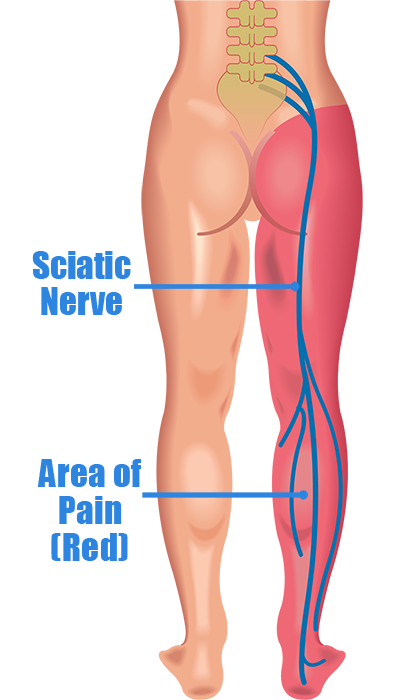
The sciatic nerve is the longest nerve in the body. Nerves from L4, L5, S1, S2, and S3 exit the low back and join together to form the sciatic nerve. The sciatic nerve then travels down the back of the leg all the way to the foot. It is responsible for supplying sensory nerves (sensation) and motor nerves (movement) to many of the muscles on the back of the thigh and leg.
What is Sciatica?
Today Sciatica is used as an umbrella term to describe symptoms that radiate down the leg. We refer to it as an umbrella term because it is a kind of “catch all” word. While the term is generally accepted as meaning symptoms down the leg, this does not describe the actual cause of the symptoms.
For example, some of the causes of sciatic symptoms are:
What are Symptoms of Sciatica?
- A herniated disc
- Low back stenosis
- Piriformis syndrome
- Hamstring syndrome
- Trauma resulting in compression
of the sciatic nerve
What are the Symptoms of Sciatica?
Depending on what structure is irritated, symptoms can range from pain down the leg, typically from the low back or buttock down to the foot. Knowing that the sciatic nerve contains both sensory and motor nerves, compression of this nerve can also lead to numbness and weakness of the leg that is affected.
People affected by Sciatica symptoms may be challenged to perform prolonged sitting or standing activities. Their walking distances are often decreased due to pain. This can directly impact functional endurance and quality of life.
What is Harter Physical Therapy’s Approach to Sciatica?

Clinically, we see Sciatica most frequently caused by an irritated nerve root in the low back. The nerve root is what the nerve is called when it first exits from the lumbar spine. This irritation can be caused by a disc pathology or a stenotic pathology that causes the hole the nerve passes through to become smaller. We are especially concerned with how much sensation and muscle strength have been impaired by this nerve pathology.
At Harter Physical Therapy we have highly trained Doctors of Physical Therapy who treat this pathology very frequently.
One of the most important steps in our approach to sciatic symptoms is to perform a thorough examination to determine the origin and cause of the nerve irritation. Once we have identified the cause, we will then use a combination of hands on skills, manual therapy, exercise, and positioning training to help reduce tension on the region of nerve root irritation which will help the nerve begin to calm down and heal. These treatments are typically not painful and our initial goal is to help reduce the pain and discomfort our patients are experiencing.
Our Doctors of Physical Therapy then will assess to see if there are any areas of muscle weakness or muscle asymmetry and provide exercises and activities to help improve these areas. Our goal with treatment is to have our patients return to their normal active life.

If you have Sciatica or would like to discuss your symptoms with one of our Doctors of Physical Therapy, call today to set up an appointment to see how we can help!

Patient Success Story
“Harter Physical Therapy is the number one place to go for PT! My therapist is Amanda Harter, one of the owners, and she is top notch in her knowledge and ability! She is kind and respectful and professional too! I have also had Katie as a therapist when Amanda is unavailable and Katie is very knowledgeable too! All staff is kind and respectful and very personable! I would definitely and have suggested Harter Physical therapy to my friends and family! I have had other places do my physical therapy and I won’t go to anyone ever again since I have had the Harter experience!”
— Talya C.
Quick & Easy Healthy Recipe
Loaded Cauliflower Casserole

You’ll never want to eat roasted cauliflower any other way once you try this tasty recipe. Bacon, sour cream and sharp Cheddar cheese coat good-for-you cauliflower in deliciousness for an easy side that will make everyone actually want to eat their vegetables.
Ingredients
- 3 slices bacon
- 1 head cauliflower (about 2 pounds), cut into bite-size pieces
- ½ teaspoon ground pepper
- ¼ teaspoon salt
- 1 ¼ cups shredded sharp Cheddar cheese, divided
- ⅔ cup sour cream
- 4 scallions, sliced, divided
Preheat oven to 425°F. Place bacon in a large nonstick skillet over medium heat; cook until crisp, 6 to 8 minutes. Transfer to a paper-towel-lined plate and let cool. (Reserve the drippings in the pan.) Combine cauliflower, pepper, salt and the bacon drippings in a 9-by-13-inch baking dish. Roast, stirring twice, until tender, about 35 minutes. Meanwhile, combine 1 cup cheese, 2/3 cup sour cream and half the scallions in a small bowl. When the cauliflower is tender, stir the cheese mixture into the cauliflower in the pan. Sprinkle with the remaining 1/4 cup cheese. Bake until hot, 5 to 7 minutes more. Chop the cooled bacon. Sprinkle the hot casserole with the bacon and the remaining scallions.
https://www.eatingwell.com/recipe/269135/loaded-cauliflower-casserole/
Exercise of the Month
Isometric Dead Bug
Start by lying on your back with your knees bent to 90-degrees and your feet raised up so your hips are bent to 90-degrees. Raise both arms up straight toward the ceiling. Make sure to keep your abdominals braced. Hold for 30 seconds.


Meet Our Team

Dr. Jana Weber
PT, DPT, OCS, CMPT

Dr. Gabe Harter
PT, DPT, OCS, COMT, FAAOMPT

Dr. Lyndsey Hubbard
PT, DPT, CHT, ATC

Dr. Katie McClellan
PT, DPT, OCS, CMPT

Dr. Micah Harder
PT, DPT, CMPT

Dr. Janet Blasi
PT, DPT, CMPT

Dr. Zach Loesch
PT, DPT, CMPT, CSCS

Dr. Andrea Murillo
PT, DPT

Dr. Amanda Harter
PT, DPT, OCS, COMT, FAAOMPT

Debra Funke
Office Manager
Let’s Get You Better ASAP!
Don’t let pain dictate your life. Take the first step towards reclaiming your mobility and well-being with our expert support. Start your journey to a healthier you today.